Blogs
Amazon SageMaker Explained: Training and Deploying Models for Customers
Amazon SageMaker Explained: Training and Deploying Models for Customers
By
R&D, FDE Academy
November 13, 2026

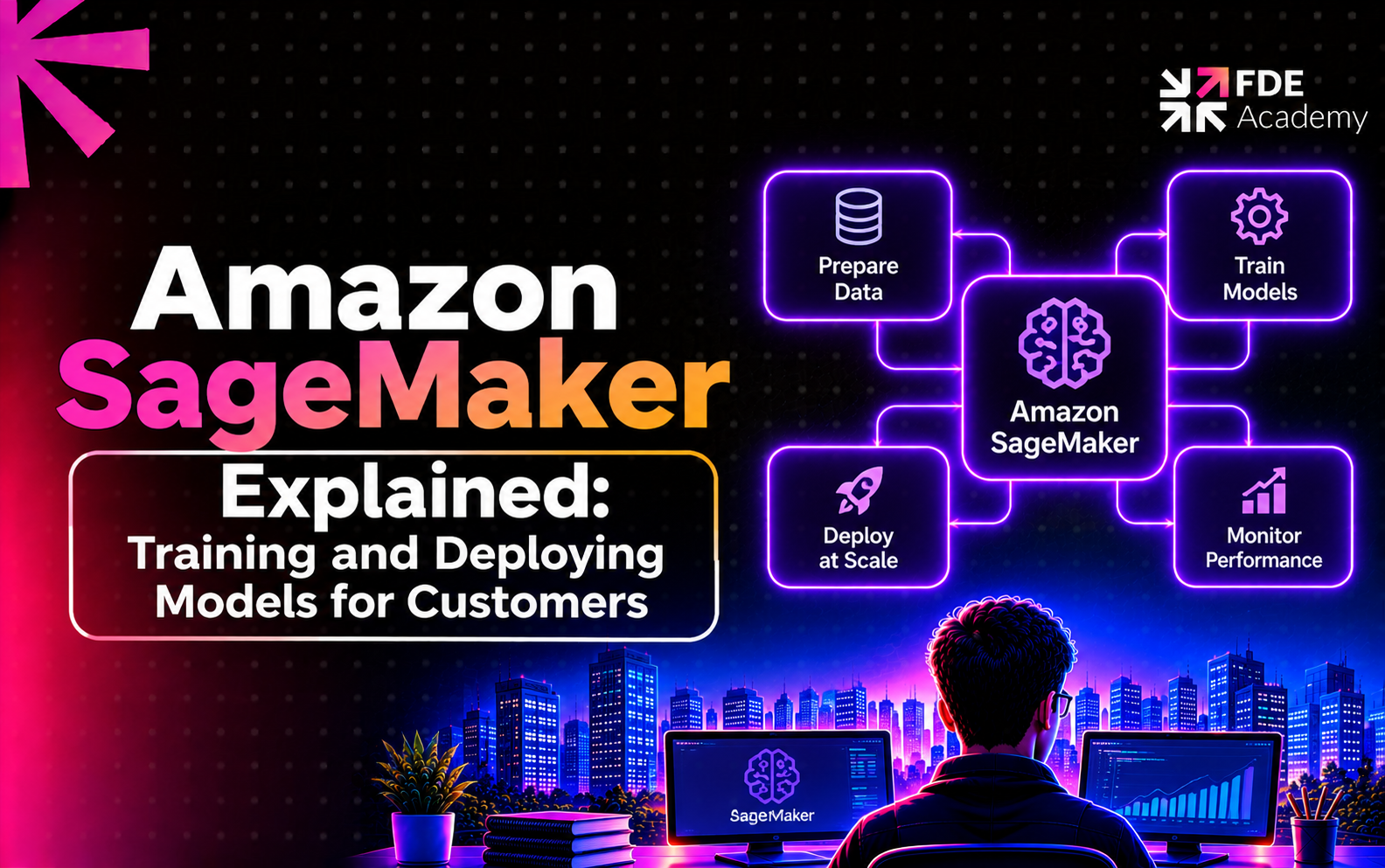
Amazon SageMaker is the service most teams reach for when a model has to leave a notebook and serve real customers. It handles the infrastructure for training, hosting, monitoring and retraining so engineers can focus on the model and the business result.
The short answer for anyone choosing a platform: pick SageMaker when you need to train or fine-tune your own models, control the runtime, or meet strict security requirements. Pick a simpler option, such as Amazon Bedrock, when calling a hosted foundation model through an API is enough.
This guide explains how SageMaker training and deployment work, how to choose between its options, and how to run a customer-facing rollout that holds up in production.
Amazon SageMaker is a managed AWS service that provides tools to prepare data, build, train, deploy and monitor machine learning models at scale, without managing the underlying servers yourself.
The naming has shifted, so it helps to be precise. The original machine learning service is now called Amazon SageMaker AI. AWS also introduced a broader next-generation SageMaker experience, including SageMaker Unified Studio, which brings data, analytics and AI work into one environment. The AWS pages that rank for "amazon sagemaker" now describe it as a center for data, analytics and AI. Documentation, tutorials and search results use the names loosely, so check which one an article means.
When people ask what Amazon SageMaker is used for, the answer is the full model lifecycle: data labeling and preparation, experiment tracking, training, deployment, monitoring and retraining.
Three questions come up constantly, and each has a clear answer.
SageMaker vs EC2. EC2 gives you raw virtual machines. You could train and serve a model on EC2, but you would build the job scheduling, scaling, model registry, endpoints and monitoring yourself. SageMaker packages those as managed features. EC2 offers more freedom, SageMaker offers less operational work.
SageMaker vs Amazon Bedrock. Bedrock provides API access to foundation models from several providers, with no infrastructure to manage. SageMaker is for custom work: training your own model, fine-tuning with full control, hosting open-weight models on chosen hardware, or running classical ML. Many companies use both, with Bedrock for fast generative AI features and SageMaker for models that need customization.
Is SageMaker considered AI? SageMaker is a platform for building AI and machine learning systems. It is not a model itself.
SageMaker training runs as a managed job. You point it at data in Amazon S3, specify a container and instance type, and SageMaker provisions the compute, runs the job, stores the model artifact and shuts the instances down.
A few capabilities matter in practice:
For customer projects, the training questions that matter are data location, reproducibility and cost. Keep customer data in the region and account they require, version datasets and code together, and set budget alarms before launching large jobs.
SageMaker inference has four main patterns. Picking the right one is the single biggest lever on cost and user experience.
Two additional features help when you serve many customers:
Multi-model endpoints host many models behind one endpoint and load them on demand. This suits cases where each customer has their own model, because it avoids paying for one idle endpoint per tenant.
Inference components and auto scaling let you allocate resources per model and scale with traffic, which controls cost when load varies through the day.
A simple rule works well: if the customer waits on the answer, use real-time or serverless. If they can wait minutes, use asynchronous. If nobody is waiting, use batch.
Training a model once is easy. Keeping it correct for months is the real job. SageMaker provides the pieces for production MLOps.
SageMaker Pipelines define the workflow, from data processing to training, evaluation and registration, as repeatable steps that can run on a trigger or schedule. This is CI/CD for machine learning.
Model Registry stores versions of each model with metadata and an approval status. Only approved versions deploy, which gives you an audit trail.
Model Monitor watches live endpoints for data quality issues, drift and bias, and can alert when inputs or predictions move away from the training baseline.
Feature Store keeps features consistent between training and serving, which prevents a common bug where the model sees different data in production than it saw in training.
Deployment safety also matters for customers. Use blue/green or canary rollouts, shadow testing against live traffic, and automatic rollback on alarms so a bad model never reaches everyone at once.
Customers will ask about security before they ask about accuracy. The standard AWS building blocks apply.
Decide these before the first deployment. Retrofitting network isolation onto a live endpoint is far harder than starting with it.
SageMaker pricing is pay-as-you-go, with charges that depend on what you use. Common cost drivers include notebook and Studio compute, training instance hours, endpoint instance hours, storage, data processing and some managed features. Exact prices vary by instance type and region, and AWS updates them, so use the official pricing page and the AWS pricing calculator for estimates.
The usual surprise is the idle real-time endpoint. A GPU endpoint left running around the clock for a low-traffic customer can cost more than the rest of the project. Control cost with auto scaling, serverless or asynchronous patterns where latency allows, multi-model endpoints for many small tenants, spot training, and budget alerts on every account.
Leaving endpoints running. Idle real-time endpoints are the most common source of surprise bills.
No monitoring after launch. Models degrade as customer behavior changes. Without drift checks, nobody notices until results go wrong.
Training-serving skew. Features computed differently in training and production quietly hurt accuracy. A feature store or shared code prevents this.
Skipping the baseline. Without a pre-launch baseline, you cannot prove the model helped.
Security as an afterthought. Public endpoints and broad IAM roles are hard to defend in a customer review.
These mirror the patterns behind why AI projects fail and how forward deployed engineers fix it: the gap between a working model and a trusted production system is integration, operations and ownership.
Training a model is a well-understood skill. Getting it live inside a customer's environment, with their data, security rules and success metric, is where projects stall.
This is the work of a forward deployed engineer: someone embedded with the customer who owns the deployment from discovery to production and the business result. On a SageMaker project that means choosing the inference pattern, wiring the pipeline, handling security reviews and staying through the first months of monitoring.
The skills a forward deployed engineer needs overlap heavily with this work, and the tech stack forward deployed engineers use includes the same model serving, orchestration and observability layers. The role also involves real engineering, as explained in whether forward deployed engineers code. Demand is growing, which we cover in why companies are hiring forward deployed engineers.
If you work with data pipelines today, the move is realistic. See the guide on going from data engineer to forward deployed engineer.
TL;DR
Amazon SageMaker is a managed AWS service for preparing data, building, training, deploying and monitoring machine learning models without managing servers directly. Its core ML service is now called SageMaker AI.
EC2 provides raw virtual machines you configure yourself. SageMaker adds managed training jobs, endpoints, scaling, a model registry and monitoring on top of compute, which reduces operational work.
Bedrock gives API access to hosted foundation models with no infrastructure to manage. SageMaker is for training, fine-tuning and hosting your own models with control over hardware and runtime. Many teams use both.
Use real-time for low-latency steady traffic, serverless for spiky or infrequent traffic, asynchronous for large or long-running requests, and batch for scheduled scoring of large datasets.
SageMaker is pay-as-you-go. Costs depend on training hours, endpoint instance hours, storage and managed features, and vary by instance type and region. Use the AWS pricing page and calculator for current figures.
SageMaker is a platform for building and running AI and machine learning systems. It is the tooling, not a model.
The world is hiring - and this Academy prepares you for it.